• Blog
  • Shop
  • Resources
  • FAQ (Ask TGS)
  • About
  • Archive
  • Contact
  • Sign In My Account
Menu

The Gentleman Stationer

Vintage Living in the Modern World.
  • Blog
  • Shop
  • Resources
  • FAQ (Ask TGS)
  • About
  • Archive
  • Contact
  • Sign In My Account

The iconic Sailor ink bottle.  It's short and wide, but it has an integrated inkwell.  I have mixed feelings about this one.  

My Favorite Ink Brand

May 11, 2016

While I'm on the subject of favorites, I thought I'd do a quick recap of my favorite brand of ink: Sailor.  Confession: I own nearly all of the current "standard" Sailor Jentle inks (everything except Tokiwa Matsu, which is essentially the same as the old Epinard), as well as multiple bottles of  the "old" Jentle inks and several special editions manufactured for Japanese retailers Bung Box and Kobe Nagasawa.  When it comes to Sailor inks, I have a problem.

My favorite color?  I can't pick just one, though the inks that get the most use are the blues: Bung Box Sapphire, and Sailor Jentle Nioi-Sumire and Souten.  However, now-discontinued Apricot holds a special place in my heart, and many people obsess over the teal green Yama-Dori due to its red sheen when it dries on the page.   

A few of my favorite Sailor Inks. 

A few of my favorite Sailor Inks. 

Why do I like Sailor inks so much?  It's a combination of deep, slightly offbeat colors, the fact that I've found the inks safe to use in pretty much any pen, and that they write really well on cheaper papers.  In a finer nib, I've yet to discover any paper on which Sailor ink won't perform at least decently.  Kiwa Guro nano-black will even write fairly well on a Moleskine and in Field Notes pocket notebooks.    

A bottle of the special-edition Bung Box Sapphire. 

Some people enjoy Sailor inks for their collectibility, and try to collect the various inks that Sailor bottles for Japanese retailers. The two most famous are the lines that Sailor manufactures for Bung Box (Hamamatsu, Japan) and Kobe-Nagasawa (Kobe, Japan). These are also the most widely available:  Vanness Pens in the United States regularly carries Bung Box, and occasionally, Massdrop will run specials on specific colors. For the Kobe Inks, you likely will have to go through eBay (retailer CoolJapan) unless Vanness restocks them.  Other special edition Sailor inks (such as those manufactured for retailers Kingdom Note and Maruzen) probably require you to use a purchasing service like White Rabbit Express, if you don't know someone living in or traveling to Tokyo who can pick up the ink for you.  I've not gone this route, so I can't advise regarding how easy/difficult White Rabbit is to use, and whether it ends up being cost effective.  

The Bad: The Bottle

One of my favorite things about purchasing Bung-Box inks used to be that they came in this vase-shaped bottle.  Apparently, this bottle is not manufactured anymore, and Bung Box inks now come in the standard Sailor bottle. 

Nothing's perfect, and Sailor ink is no exception.  What's the one thing I would change?  The bottle.  Sailor inks come in a short, wide bottle that can be difficult to use with larger-nibbed pens.  I've even had trouble from time to time getting Sailor pens to fill completely if the bottle is less than half full.  At one point, I hoped that Sailor would permanently move to the taller, vase-shaped bottle they used for certain of their Japanese special editions, including Bung Box, but these bottles have since been discontinued.  (Why, Sailor?  WHY!?)

Final Thoughts

If I could encourage someone new to fountain pens to try a single brand of bottled ink, it would be Sailor.  The colors are fun, unique, and most important of all, can't really be duplicated elsewhere (and certainly not in any ink that's available in cartridges).  I know I keep going back to this, but one thing that's really important to me is performance on cheap paper. For many people just starting out with fountain pens, they haven't yet discovered or stocked up on higher-end paper, and they can become easily discouraged with inks that tend to feather and bleed through anything other than Rhodia or Clairefontaine. Sailor as a brand performs better than most. 

The standard Sailor Jentle line is also relatively inexpensive for such high-quality ink that comes in a range of colors.  Retail pricing is anywhere from $12 (for standard blue, black, blue-black) to $18 for Yama-Dori, Souten, etc.  Pigmented inks such as Kiwa Guro are priced at a slight premium (around $21), but if you are looking to import the special Japanese editions, be prepared to pay as much as $43 per bottle.  Occasionally, Amazon sellers will have specials on specific colors.  For example, you can currently snag a bottle of Yama Dori or a bottle of Shigure (purple) for less than "full retail".  

Why have I personally focused on finding a "favorite brand" of ink?  When you find one that you can load into any pen, without worrying about how that ink will perform on basically any paper, then it adds an entirely new level of satisfaction to your writing experience.  I easily could see myself start using Sailor ink exclusively.  

But how about you?  What are your favorite ink brands?  I'm interested to see what people's thoughts are.    

DISCLAIMER:  This post contains affiliate links, through which I may be compensated a small amount if you purchase something from any of the sites linked to in this article.  While I'd greatly appreciate it if you use these links to purchase an item you are interested in, you are, of course, under no obligation to do so.  Many thanks! 

In Editorial, Ink Reviews Tags Editorial, Inks
6 Comments

The Pilot Hi-Tec-C Coleto is my favorite multi pen.  The top pen is the Coleto Lumio, a slightly higher-end body, and the bottom pen is the standard Coleto, which typically costs around $3.  

The Hi-Tec-C Coleto: Getting into the Multi Pen Game

May 7, 2016

I don't own a lot of multi pens.  Two, to be exact, and they're both different versions of the same pen:  the Pilot Hi-Tec-C Coleto.  To me, the multi pen evokes images of those chunky Bic multi pens they used to sell at the grocery store (or hey, maybe they still do), which would work for about a day before they crapped out.  So I ignored multi pens for many years.   

As the story usually goes, of course, I started listening to the Pen Addict Podcast and learned about the joys of the Pilot Hi-Tec-C.  The Hi-Tec-C is my go-to ultra fine-point gel pen, but I often color-code my notes and there are certain times, like when I'm traveling, where it's inconvenient to carry around a fistful of gel pens in different colors or multiple fountain pens loaded with different inks. That's where the multi pen comes into play.

The Coleto makes it easy to see what color refills you have loaded in the pen. 

What I like about the multi pen is that it is completely customizable.  My personal favorite is my Coleto Lumio, a higher-end model that comes in matte black.  I have it kitted out with a .5mm mechanical pencil and .4mm blue-black, orange, and purple refills.  For situations where I don't want to carry multiple pens on me, it's a complete solution.     

The cap of the Coleto flips up, allowing you to drop in the refill. The gray refill on the left is a .5mm mechanical pencil cartridge. 

If you're interested in dipping your toes into the world of multi pens, the Coleto is a great place to start.  The Coleto Lumio is more expensive and harder to find, but is a very professional and nice-looking matte-black pen.  (Other colors are available, too.)  One of the great things about multi pens is that unless you are going really high-end, like certain models of the the Zebra Sharbo X or the Lamy 2000 multi pen, you're probably not going to spend more than $30, and often much, much less.  At least not on the pen body itself. 

Where multi pens eventually will get you is on the refills.  The Coleto is far from the worst on this point: you can buy the refills in bulk to get the price down to about $1-2 apiece, and they last for a reasonably long period of time if you use them for moderately intense writing tasks like jotting down ideas in your Field Notes.  However, if you're using a pen like the Zebra Sharbo X that takes smaller D1 refills, you will burn through the refills like there's no tomorrow, especially if you write a lot.  You can offset the cost by avoiding D1 gel refills and moving to a hybrid ballpoint-gel ink like the Uniball Jetstream version, which last a good bit longer. 

The Coleto sports the same ultra-fine point that made the original Pilot Hi-Tec-C famous. 

The Hi-Tec-C Coleto refills come in .3mm, .4mm, and .5mm sizes.  As I mentioned, you can buy bulk color assortments until you figure out which particular colors you like, then stock up individually. [Note: as of 2024, we have opened our own pen shop and are now happy to announce that we sell the Pilot Hi-Tec-C Coleto directly, along with the refills. The specific models listed in this review are nearly 10 years old and no longer available, but the Coleto 1000 and Coleto 500 are the new equivalents.] 

Further Reading

If you're interested in reading other people's takes on the Hi-Tec-C Coleto, you should check out Brad's review of the Coleto Lumio over at the Pen Addict, as well as Azizah's over at Gourmet Pens. 

DISCLAIMER:  I purchased the pens featured in this review with my own funds, for my own collection.

In Multi Pens Tags Multi Pen, Hi-Tec-C, Coleto, Pilot
1 Comment

Diamine Terracotta is an excellent ink.  Check out my review over at Bottledup.ink.

BottledUp.Ink: Where My Ink Reviews Went

May 6, 2016

You may have noticed that I've been doing fewer ink reviews on this blog.  That's because I've mostly moved them over to a Tumblr I run, Bottledup.ink, though so far I've done an extraordinarily bad job letting you all know that.  I've recently posted a couple ink reviews (mainly photographs) of Sailor DoYou and Diamine 150th Anniversary Terracotta over there, so please check it out.

Sailor DoYou is another very dark brown that I've been enjoying.  A full review is up on the TGS Tumblr.

I made the decision to give ink reviews their own site since it seems like there is less demand for them than other kinds of content, and as a result I was having a hard time justifying fitting them into the rotation.  Also, I've set the Tumblr up so that you readers can submit your own ink reviews if you so desire.  So far, nobody's taken me up on that offer, but the invitation stands!

If you follow me on Instagram, I periodically post ink-related stuff over there, and anytime the Tumblr is updated you should get a notification if you follow me on either Tumblr or Twitter.

Happy Friday!   

In Editorial, Ink Reviews Tags Ink Review, Tumblr
Comment

A couple Deltas, a Pilot, and a Sailor (with an Edison and a Monteverde thrown in for good measure) 

My Top Three Favorite Pen Brands

May 4, 2016

People write a lot about their favorite pens, but over the past several months I've been thinking about my favorite pen brands.  After giving this question some thought, I considered a few things: 

  1. What pen brands, if any, could I recommend to others, without really worrying about recommending a specific model? 
  2. What pens give me, personally, the most joy to use on a daily basis? 
  3. What pens are most represented in my own collection? 

The results here may not surprise followers of this blog, though number 3 was a bit of a surprise to me. Without further ado: 

Pilot's Kakuno fountain pen is a great entry-level model. 

Pilot.  When picking my overall favorite pen brand, without naming a specific pen, it would have to be Pilot.  At every price level, from inexpensive "beginner" pens to very expensive urushi and makie models, you really can't go wrong.  The key selling point for me is the consistency of Pilot's nibs. Without exception, every Pilot nib I have used has been excellent. This applies across the product range:  from the steel nib on the entry-level Pilot Metropolitan and Kakuno to the more expensive Pilot Custom Heritage 92 or the Pilot Custom 823.  What made Pilot number 1?  The fact that I feel like I can recommend Pilot as a brand to anyone and still have confidence they will be able to find something there they like. 

My most recent Sailor Pro Gear acquisition, the Bung Box "Soleil" model (review coming soon).

Sailor.  On the other hand, Sailor is probably my personal favorite, if that makes sense, meaning that Sailor pens are most heavily represented in my own collection and give me the most pleasure to use. Sailor's Pro Gear model is probably my favorite pen of all time, and I have several of them:  the Pro Gear Imperial Black, the Pro Gear Sky, the limited edition "Realo Soleil" model by Bung Box, and something new on the way.  Why do I like the Pro Gear?  It fits my hand really well, and the nibs, while stiff, almost always write well without tuning. Unlike Pilot, however, Sailor focuses on higher-end pens.  Entry-level Sailor pens do exist, but I've heard mixed reviews and they are not widely available.

Delta Dolcevita Soiree with the iconic Delta logo on the cap. 

Delta. This one was something of a surprise for me, but it turns out that I've somehow managed to acquire a lot of Deltas.  Delta is an Italian brand that offers a wide range of pens across a variety of price points. Recently, I reviewed the flagship Dolcevita (in the Soiree model), and in the past I've also looked at the Fusion 82.  While perhaps not quite as reliable as Pilot, I've had a near-perfect record of Delta pens writing perfectly out of the box, and they are one of a handful of pen companies that still issue pens in celluloid, a vintage-style material that I love and collect.  

Honorable Mention.  Platinum and Pelikan both have received increasing amounts of attention from me. I'm thoroughly enjoying the Pelikan M800 Burnt Orange that I picked up at the Atlanta Pen Show last month, and my Platinum 3776 with the ultra extra-fine (UEF) nib has become a near-daily user for detailed note taking after Mike Masuyama tuned it.  However, I don't yet have enough experience using either of these brands to dethrone one of the current top three.  In a year, that might change... 

It was interesting to spend some time going through my collection this weekend and looking at things from a macro perspective (as in, on a brand-by-brand basis instead of a pen-by-pen basis).  Eventually I'll need to update my Tier One Pens list, as some changes are overdue.     

DISCLAIMER:  This post contains affiliate links, through which I may be compensated a small amount if you purchase a pen from any of the sites linked to in this article.  While I'd greatly appreciate it if you use these links to purchase something you are interested in, you are, of course, under no obligation to do so. Many thanks!  
In Editorial, Top 5 Tags Top Pen Brands, Pens, Delta, Pilot Namiki, Sailor
3 Comments

Edison Menlo in Tibaldi Celluloid with clear acrylic ink window. Currently inked with Montblanc JFK Navy Blue.

Pen Review: Edison Menlo in Tibaldi Impero Celluloid

April 30, 2016

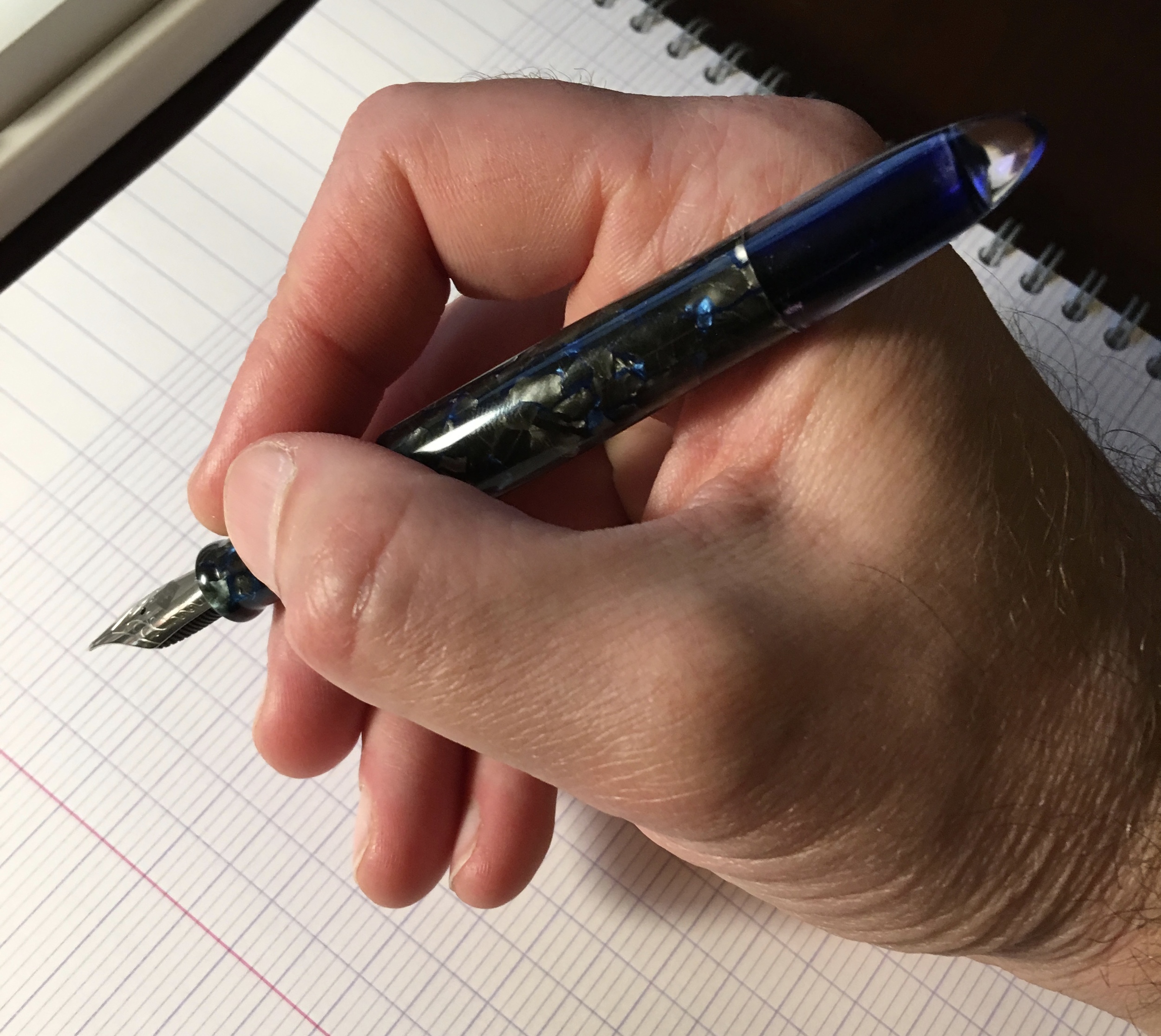
I've owned several Edison pens over the years:  a Pearlette, a Herald, and a Mina (unfortunately never reviewed).  And while I've enjoyed the pens, I've never found a shape and a material that I truly loved enough to make the pens stick in my collection.  That may change with the Menlo. 

View fullsize Edison Menlo in hand
View fullsize Edison Menlo unposted
View fullsize Edison Menlo posted

The Menlo is definitely my favorite of all of the Edison pens that I've tried to date.  I prefer the more slender torpedo shape that sits well in the hand and is comfortable to write with posted or unposted.  Since this pen does not have the brass pump filling system that the Menlo is known for, it's extremely light and perfect for longer writing sessions.  I have it filled as an eyedropper, so it also has an enormous ink capacity.  I haven't measured it yet, but my best guess would be around 4ml.  The ink lasts a long time on one fill.  

The Material:  Discontinued Tibaldi Celluloid

This pen is made from Tibaldi "Impero" celluloid, which is no longer available so I snatched this pen up as soon as I saw it come on the secondary "Slack" market.  This particular celluloid might be the most beautiful material I've ever owned.  It's a mixture of black, graphite, and gray pearl intermixed with veins of bright blue (think "Bung Box Sapphire" blue).  Photographs don't do the celluloid justice:  the material appears much darker on the screen than it does in real life, and you can't get a good sense of the depth of color and complexity of the design.  

Tibaldi Impero celluloid is notoriously difficult to photograph.  It's hard to capture the full range of colors running through this material. 

A lighter picture in which I tried to capture the detail in the material a bit more. 

This custom pen also features a clear acrylic ink window, which can serve as both a reminder of the color ink you have in the pen and a "warning light" to let you know when you're about to run out.  A big thank you to my friend and fellow Pen Addict "Slacker" Phil for commissioning this design, and then passing it along for sale!       

Once you can see the ink level through the window, 

A word of caution about celluloid pens:  they can stain.  Usually, I would not use a celluloid pen body as an eyedropper (or even as a Menlo pump-filler) because the ink is constantly in contact with the material, and will eventually cause the pen to discolor.  Because the Tibaldi celluloid is so dark, however, I haven't had any problems with noticeable staining from blue, black, or blue-black inks.  

A Note about Edison Nibs

You observant readers may have noticed that I've already reviewed the nib on this pen.  The GREAT thing about Edison Pens (and Franklin-Christoph pens, and Scriptorium pens, and Newton pens) is that the nibs are interchangeable.  The Edison Menlo accepts #6 JoWo Nibs, so I swapped out the stock extra-fine that came with this pen for my Franklin-Christoph Masuyama Broad Cursive Italic that I purchased with my Pocket 66.  I love this nib.  The cursive italic grind has excellent line variation, and is a slightly drier writer than a stub nib, which makes this nib an excellent choice for work. 

Pricing

The Menlo is an Edison "signature line" pen, meaning that it's custom-made to order, and because the standard Menlo has the fancy filling system, prices start at $350.  You would need to confirm with Brian Gray of Edison, but I believe the price for an eyedropper or cartridge/converter Menlo would be $250, since you would not have the added cost of the pump filler.  You also may have added cost depending on the material you choose and whether or not you opt for a gold nib.  Brian's pricing is standard for a custom pen, and to me represents good value. 

I'm a big fan of what Brian is doing over at the Edison Pen Company.  His pens are of excellent quality, and he has a wide range of offerings suitable for many different tastes.  He will also work with you on completely custom designs.  I highly recommend you check him out. 

Disclaimer:  I purchased this pen with my own funds for my own collection.  I have not been compensated in any way for this review.

In Pens Tags Edison, Edison Menlo, Pen Review
Comment
← Newer Posts Older Posts →
Store Hours and Location
Visit the T.G.S. Curated SHOP
Updated "Best Pens" Guide
On the Paper Trail Podcast
TGS x Roterfaden TGS_25
Hierarchies of Fountain Pen Friendly Paper

Join Our Patreon!
Subscribe to the TGS E-mail List

Featured Posts

Featured
Cover On the Paper Trail Intro Clip.jpeg
Dec 3, 2025
Introducing "On the Paper Trail," a New Podcast/Video Collaboration with Lisa Vanness of Vanness Pens!
Dec 3, 2025
Dec 3, 2025
Iro-Utsushi-Fine-Dip-Pens.jpeg
Oct 1, 2025
The Pilot Iro-Utsushi Dip Pen (and in General, Simple vs. Fancy Dip Pens)
Oct 1, 2025
Oct 1, 2025
Levenger-Annotation-Pad.jpeg
Sep 20, 2025
Five Boutique Paper Brands I'm Watching Closely and Why
Sep 20, 2025
Sep 20, 2025
The Gentleman Stationer RSS

© Digital Divide Media, LLC, 2014-present.

All content is the exclusive property of Digital Divide Media, LLC, d/b/a The Gentleman Stationer, including “The Gentleman Stationer” website and trademark, and should not be reproduced without express written permission.  All rights reserved.

All content containing paid advertising, affiliate links, or sponsored content will be plainly disclosed by a disclaimer when/if featured.

Contact Information

Store Shipping Policy and Return Policy

Privacy Policy

Cookie Policy

Terms and Conditions

Powered by Squarespace