• Blog
  • Shop
  • Podcast
  • Resources
  • About
  • Archive
  • Contact
  • Cart
  • Sign In My Account
Menu

The Gentleman Stationer

Vintage Living in the Modern World.
  • Blog
  • Shop
  • Podcast
  • Resources
  • About
  • Archive
  • Contact
  • Cart
  • Sign In My Account

The Best Paper for Everyday Writing, Part VI: Legal Pads

October 18, 2023

While I had originally envisioned “The Best Paper for Everyday Writing” as a five-part series, based on reader questions, I thought it made sense to expand it to include a stand-alone article on “Legal Pads”. I’ve placed the term in quotation marks because it’s regularly used to describe several very different types of stationery, ranging from the traditional 8.5” by 14” U.S. “legal-sized” pad of paper to any writing pad that is glue-bound on top and features detachable perforated sheets. I use the broader definition, since in my experience as an attorney fewer and fewer people are using actual legal-sized paper each year, and most of the legal pads I see in everyday practice now feature either letter (8.5” x 11”) or A4 (8.3” x 11.7”) sizing.

The main question I get from readers is very straightforward: What is the best fountain pen friendly legal pad available today? The answer, however, is NOT so obvious, because people prioritize different things. For example, many office workers will churn through a lot of legal pads (think three or four per week), so they look for the least expensive option with acceptable fountain pen performance. I don’t go through as many pads as I used to, so I no longer take this approach myself. Therefore, I’m not up to date on which Amazon or eBay brand of inexpensive legal pad is currently using decent paper - batch performance tends to change from year to year or even month to month. I tend to stick with slightly more expensive paper that delivers consistent performance with fountain pens, rollerballs, and fineliners, and that is how I’ll approach this post.

In my mind, a classic “legal pad” has to allow you to easily fold sheets over the top, and feature a backing board sturdy enough to permit notetaking while standing up. In order to write on both sides of the page, you will have to tear the page out (hence, perforations).

My Favorite Fountain Pen Friendly Legal Pads

  1. Clairefontaine “Pupitre” Writing Tablets. My long-time favorite for a legal-style writing pad remains the classic Clairefontaine “Pupitre” series. Available in A4 and A5 sizes, this durable writing pad is both glue and staple-bound across the top, and features a wrap-around cover in addition to a thick chipboard back for maximum durability and ease of use while standing. The combination of paper quality and high-end construction has kept this pad at the top of my list for many years, and I can’t recall a time when I didn’t have at least three of these in my office desk.

  2. Rhodia A4 Dot Pads. The reliable Rhodia Pad can be found pretty much anywhere these days, including in big-box art supply and craft stores, so they get extra points for availability when you may not have a brick-and-mortar pen store nearby and need quality paper quickly. Also, when I’m looking for dot grid paper, which can easily be turned sideways to use in a “landscape” orientation, Rhodia is my go-to. Of course, Rhodia pads are available in other rulings and a wide range of sizes. I place them at No. 2 on this list, essentially tied with Maruman Mnemosyne, for the same reasons discussed below.

  3. Maruman Mnemosyne A4 Pads. Basically, Maruman Mnemosyne pads tie with Rhodia after Clairefontaine in my book, with Clairefontaine given the edge due to the slightly sturdier build. Rhodia edges out Mnemosyne based on availability. That said, Mnemosyne paper is excellent quality, and if you enjoy having a dedicated space for a header at the top of the page, their layout makes it very easy to organize your notes. Maruman also makes a range of portfolios/padholders across a range of price points, including both PVC and vegan leather options.

  4. Write Notepads Memo Pads. Featuring excellent paper and versatile layouts that include a “Meeting” format, these memo pads are sold in packs of two and therefore also offer good value. While the Write Memo Pads have a backing board, they don’t have a cover like the first three pads on this list, so they’re not quite as durable for portable use, but I’ve absolutely used them in a portfolio. Note that these are letter-sized (8.5” x 11”) and not A4.

  5. Plotter A4 Pads. DesignPhil’s proprietary paper is exceptionally fountain pen friendly, but the A4 writing pad itself is (1) tailored toward users of the Plotter system, and (2) suffers from durability issues that will keep most people from using this as an everyday legal pad. You can use the Plotter A4 pads in either traditional “portrait” or “landscape” mode (i.e., horizontally or vertically), and the paper comes hole-punched for an A5 Plotter binder along the top edge. Because A5 is exactly half the size of A4, you can simply fold the sheet in half (or do a tri-fold) to carry with you in your binder. As a fairly heavy Plotter user, I’ve been experimenting with one of these pads in my A4 Roterfaden, and the primary drawback is that the pad doesn’t have a sturdy backing board or binding and falls apart fairly easily. This product appears to be designed primarily with desk use in mind, where you tear the sheets out one by one as you use them.

Honorable Mention: Midori MD and MD Cotton Writing Pads

Intended more as a desk pad than a traditional legal pad, the Midori MD and MD Cotton pads are glue bound on two sides (crosswise and lengthwise), which ensures the paper lies flat and prevents “curling” of pages as you get to the end of a pad. I include these as honorable mention because, while you can’t use them easily in a portfolio or padholder without breaking the binding, they are excellent pads of paper and can absolutely be used to take legal pad-style notes as necessary.

Thick backing boards on the Clairefontaine Pupitre (top), the Write Notepads Memo Pad (middle), and Maruman Mnemosyne (bottom).

Further Reading

To catch up on the rest of the “Best Paper for Everyday Writing” series, check out our “Best Paper” Resource Page. I may need to do yet another post in the series in response to several reader requests for recommendations on pads for letter writing and written correspondence, which is an entirely different category (though again there may be some overlap). Stay tuned!

The Gentleman Stationer is supported entirely by purchases from the T.G.S. Curated Shop and pledges via the T.G.S. Patreon Program. This post does not contain third-party advertising or affiliate links.
In Editorial, Paper Products, Top 5 Tags Best Paper, Legal Pad, Editorial
1 Comment

I was able to get a LOT of writing done this week.

Back from Vacation! Recapping The Year In Pen Show Travel, Upcoming Shows, Etc.

October 14, 2023

Since we are back in town today, any orders placed over the past week should start shipping out this afternoon, and you will see labels and tracking numbers being generated over the weekend. Remember - all orders placed in the shop through 11:59pm Sunday (10/15) will receive some of the new/restocked T.G.S. Swag that I recently ordered! Many thanks for continuing to support us while we were out on this much-needed break!

To recap 2023 a bit: I attended a lot of pen shows! If you’ve missed reading about my year in pen-related travels the first time around, I’ve linked to most of my show recaps below.

  • NY NOW and Shoppe Object (Trade Show, not a Pen Show, but it was still fun!).

  • 2023 Baltimore Pen Show

  • 2023 Arkansas Pen Show

  • 2023 Atlanta Pen Show

  • 2023 Washington, D.C. Fountain Pen Supershow

  • 2023 San Francisco Pen Show

Maybe I’m looking forward to hunting more vintage in Ohio?

I don’t currently plan on doing any additional shows as a vendor this year, though as I mentioned I may attend the Ohio Pen Show during the first weekend of November. Other shows taking place during October include the Colorado Pen Show (this weekend!) and the Detroit Pen Show next weekend (October 20-22, 2023). The Scriptus show also takes place in Toronto on October 29. You still have several opportunities to get a pen show in before things shut down in November and December. Stay tuned as I will continue to be off from the day job through the first week of November, and have a bunch of fun content planned!

In Editorial, Travel Tags Pen Shows, Travel
Comment

Adventures in Pen Travel and Pens for Vacation, 2023 Edition

October 11, 2023

Now that I’ve had a few days to decompress, It seems like a good opportunity to talk a bit more about my travels over the past two months, the ongoing “hard reset” of my work and personal life, and, of course, my marathon pen cleaning session last week.

I recently announced that I’m changing day jobs, which is a big move for me. I held my old position for nearly 10 years, and while I won’t be changing employers, I’m stepping into a role that (1) involves less of an overall time commitment; and (2) has fewer administrative responsibilities. One reason for the shift is the rapid growth of T.G.S. - while it’s not yet a full-time project, it requires more attention each month, and I’m of course more than happy to rearrange my working life to accommodate the expansion. That said, it’s likely going to require a complete reorganization of my workflows and how I go about my daily working life if I want to keep things manageable.

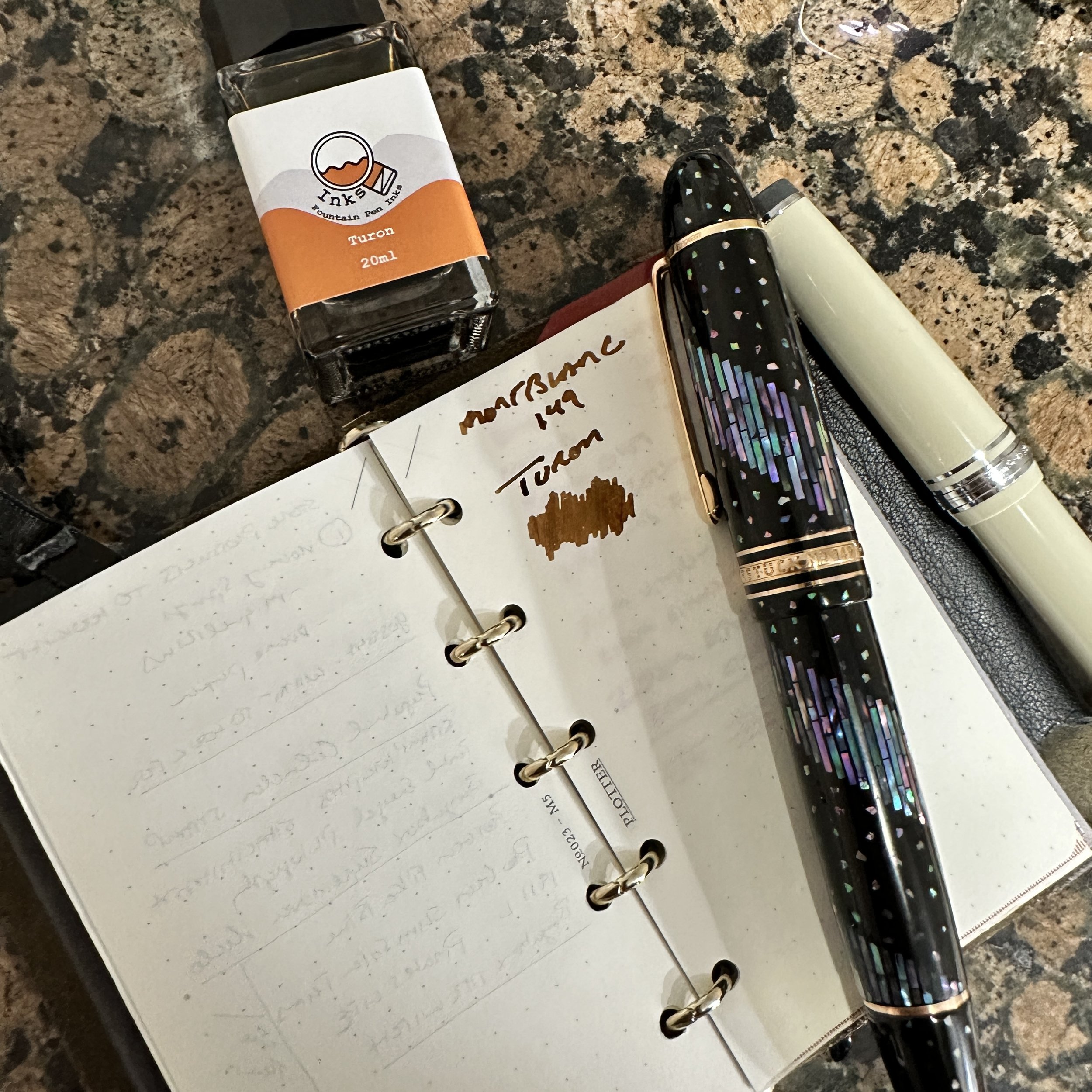
These two pens - shown here with a new ink I tested at the Dallas Pen Show - stayed in rotation!

The biggest change is the lack of formal structure. My new duties are primarily project-based, allowing me to work mostly remotely, on my own schedule. Outside of the posting routine that I’ve fallen into over the years, T.G.S. also doesn’t have a “schedule”, so my greatest concern about the new arrangement involves my ability to structure my time in a way that ensures that (A) I get everything done, and (B) I keep work confined to “regular” hours as much as I can, allowing me to have a greater semblance of a personal life that includes picking back up other hobbies and interests that I’ve necessarily had to let slide. Case-in-point: I’ve not done nearly as much personal writing and journaling as I would have liked over the past year, despite having a half-dozen notebooks “in rotation” and 30+ fountain pens inked up.

The 10 pens I took with me on vacation, identified and discussed below from left.

Current Setup: Fountain Pens

While of course there’s a lot that I’m thinking through and working on that I can’t publicly discuss here, I CAN tell you what I’m doing about my pen problem. The first order of business was to flush 20 or so pens, most of which had been inked for the Washington, D.C., San Francisco, and Dallas Pen Shows. The cleaning process was aided considerably by the Schon DSGN Luer Syringe Cleaning System, which Ian kindly gifted me in San Francisco to test out. The system consists of a series of fittings designed to attach to the section and/or nib unit of your pen, with different attachments made to fit JoWo, Bock, Pilot, and Sailor (with more to come). You can then thread a 1cc syringe into the fitting and easily flush out a pen in much less time than it would take you to clean using a converter, and with less mess than a bulb syringe. I left nine pens inked up, which I’ll identify from the photo above, listed from left:

  • Santini Libra in Blue Swirled Ebonite: This pen is on loan from a friend, and I left it inked because I need to write with it and get it reviewed so I can return it to her! Santini pens have long interested me because they are made entirely in-house, nibs included! Though Santini visited this year’s D.C. Pen Show, I was disappointed that I didn’t have the chance to visit their table.

  • Leonardo Momento Zero in Bohemian Twilight Resin. Jonathan Brooks’ Bohemian Twilight material is one of my favorites, and I couldn’t resist the opportunity to pick one of these up since I didn’t yet have a pen in this material in my personal collection. The ink I chose to pair with this pen? Queen Alexandra’s Birdwing Butterfly Green, from the recently released Anderillium Lepidopteran Series. It’s a slightly brighter dark green than the swirls in the pen, which complements it perfectly.

  • Conid Bulkfiller Kingsize. I’m torn on Conid, and I’m still trying to figure out how I feel about the brand, especially compared with the Kyuseido Kakari (discussed more below). While extremely well-constructed, I’m not loving the Bock Titanium nib, and I hope to soon procure a gold nib option because I need more consistent inkflow and less of a “squeaky” writing experience. This pen is currently inked with Nahvalur “Dark Forest,” an excellent ink that I plan to review in more detail as soon as I’ve had the opportunity to try more from the series.

  • Sailor Pro Gear “Moonlight over the Ocean”. I’ve long loved the form factor of the Sailor Pro Gear, and odd name aside, this edition spoke to me so I picked one up for my personal collection. It’s inked with Anderillium Atlas Moth Brown, also from the Lepidopteran Series. For some reason I thought this pen needed a good brown-black ink?

  • TWSBI Diamond 580 ALR “Sunset Yellow”. I always have a TWSBI inked and in rotation, and the one I haven’t been able to put down is the recently released “Sunset Yellow,” - really more of an orange gold. The matching ink is Monarch Butterfly Orange, from yet again, the Anderillium Lepidopteran Series.

  • Montblanc 149 in Rose Gold with Bokumondoh Urushi Work. This pen will stay inked for the foreseeable future because it’s beautiful, and the result of a year spent on the Studio Bokumondoh wait list. Fittingly, when I reviewed this pen nearly three years ago I was on vacation in the same spot I’m sitting in now typing this list.

  • Kyuseido Kakari Fountain Pen. The Kakari is the first pen release from Kyuseido, the new company recently started with C.Y. of Tokyo Station Pens and the Tokyo Inklings podcast. I chose the black PVD titanium version, with a Sankakusen nib grind. It’s worth reading Kyuseido’s description of the “Pump-Piston” filling mechanism - you’ll see why this pen is of interest to so many people. The pen is currently inked with unobtanium: Diamine “Suman” created especially for this past year’s Manila Pen Show that a friend was kind enough to gift to me.

  • Nagasawa Kobe Affection Kyomachi Legend Blue Sailor 1911L. My friends at Vanness Pens are now the exclusive U.S. retail partner for Kobe Japan-based Nagasawa Stationery, and I couldn’t resist taking home two of their current Sailor collaborations from the Dallas Pen Show. The first is the 1911L version of the “Kyomachi Legend” pen, which features a metal section similar to that on my 1911 Black Luster. Currently I have this pen inked with Sailor Souboku in cartridge form. Perhaps the most surprising aspect of this pen is the broad nib I chose. I’ve never used a Sailor Broad (which frankly writes very much like a JoWo medium), and I’m enjoying it.

  • Nagasawa Kobe Pro Gear Mini “Mouette”. The two-toned grey on this one got me, along with the fact that this edition of the Pro Gear Mini doesn’t have threads on the end of the barrel, allowing for quicker deployment. I inked this one up with Taccia Hiroshige-Ainezu, a beautiful grey that I’m enjoying.

Current Setup: Notebooks

I took four notebooks with me: My Roterfaden A5 kitted out with my Laconic Monthly Calendar and two Plotter pads; my older (and now-discontinued) Traveler’s-sized Roterfaden with a few blank Traveler’s Midori MD refills; my Midori 5-Year Diary, and a Bank Paper journal from Atelier Musubi. As I mentioned above, I haven’t done much personal journaling and want to experiment with different formats. So far I’ve managed to write each day for at least an hour! What didn’t I bring? My Plotter notebooks. I use them more as binders to organize papers by topic, and since I’m not actively working on any projects this week I decided to leave them at home as I can incorporate pages from the Plotter notepads as necessary upon my return.

One goal of mine is to streamline my everyday carry. As I journal more, I want to finish up several notebooks “in progress” and limit what’s active going forward.

I hope you enjoyed this little tour of my current stationery life! As you might imagine, things are a bit chaotic right now, but in a good way, as I’m excited about what’s to come. Stay tuned as I have much more to announce over the coming month!

The Gentleman Stationer is supported entirely by purchases from the T.G.S. Curated Shop and pledges via the T.G.S. Patreon Program. This post does not contain paid advertising or third-party affiliate links.

In Editorial, EDC, Travel Tags Travel, Editorial, Notebooks, Pens
4 Comments

From left: Schon DSGN Pocket 6, Sailor Pro Gear Sapporo Mini Mouette; Kaweco AL Sport, and Traveler’s Company Brass Fountain Pen (Factory Green Special Edition).

Pocket Fountain Pens, Part II: Further Reflections on Pocket Carry

October 4, 2023

Back in January, I wrote a piece in the “Workhorse Pens” series that I had been thinking on for quite some time, titled the “Considerations and Pitfalls of High-Capacity Pocket Fountain Pens.” The specific focus of that article was what I refer to as “pocket ink tanks,” namely high-ink-capacity pocket pens with either a piston, vacuum, or eyedropper filling system. While it can be extraordinarily convenient for those of us who do a lot of writing to carry a full 4ml of ink around in our pocket - and some of these pens do indeed seemingly write forever - there are all sorts of caveats that you need to consider in order to avoid a pocket ink-splosion.

Yes, pocket pen converters do exist! Kaweco (left) and Sailor (right).

But what about pocket fountain pens that use a standard ink cartridge-converter filling system? Are they any “safer”, and to what extent are they subject to the same risks and considerations as the so-called ink tanks? The short answer is that cartridge-converter pocket pens are fairly low-maintenance and easy to use, but still require some attention in order to ensure an enjoyable writing experience. A few thoughts and observations:

  • Because cartridge-converter pens hold less ink, there’s proportionately less risk of a mess, but still a risk of a mess. Trust me, if a fountain pen ink cartridge explodes, it will cause a big mess. (Especially if you put it through the washing machine.) But it’s not 4ml worth of mess, and the ink is doubly contained, both within the cartridge, and then again within the barrel of the pen. If your pocket fountain pen has o-rings set into the cap and barrel threads, you’re even less likely to ruin your bag or clothing provided you’re always careful when uncapping the pen after travel.

  • Cartridge-converter pocket pens are less prone to burping and leaking into the cap. Because the ink is held inside the cartridge or converter, which in turn is inside the barrel, it’s more insulated from temperature fluctuations, which can cause “burping” - i.e., what happens when warming ink expands and gets pushed out of the nib and feed. There’s no way to eliminate the risk entirely, especially if you carry a fountain pen in your pants pocket, but I’ve had much less trouble with cartridge-converter pens than those that use the barrel itself as the ink reservoir.

  • Be mindful of condensation in the cap and the pen getting jostled around. No matter how careful you are, you can’t outsmart the laws of physics and thermodynamics. If you carry a fountain pen in your pocket, it’s really just a plastic or metal tube of ink that writes via a “controlled leak” through the nib and feed. If the pen gets bumped, or you’re particularly active, a drop or two of ink might leak out into the cap or onto the nib. If the pen warms up in your pocket, you might see some inky condensation on the nib. There’s no avoiding these things, so no matter what kind of pocket fountain pen you are using, use some caution when you uncap it for the first time to avoid getting any stray drops onto your clothes, desk, bag, etc.

The nib on the Sailor Pro Gear Mini Sapporo - you can see some dried ink that leaked out onto the nib when I was carrying it on my Plotter Mini 5 in my pocket on an airplane. It’s minimal, to be sure, and there was no real mess, but it’s a factor to consider.

A Few Examples of Low-Maintenance Pocket Fountain Pens

I pocket carry fountain pens all the time, both cartridge-converter pens as well as the pocket ink tanks. I generally won’t hesitate to carry any of my more compact fountain pens in my pocket as long as I’m conscious of not doubling up with keys, knives, etc. Of course, the quintessential cartridge-converter pocket fountain pen is the Kaweco Sport, which has a low barrier to entry and ease-of-use, as well as tons of different materials and finishes to choose from. Honestly, if you hear the term “pocket fountain pen,” most people immediately think of the Sport, to the degree that pen has almost become synonymous with the product category.

Two-toned grey? Sign me up.

It’s not the only option, however. A favorite of mine - though at a higher price point - is the Schon DSGN Pocket 6, which comes in a wild array of finishes, is compatible with Ian Schon’s in-house Monoc Nib, and features durable metal construction (complete with o-rings to protect against leaks). I’ve also had good luck with the Traveler’s Company Brass Fountain Pen, based on a traditional “bullet pencil” design. And of course I recently reviewed the Wingback Fountain Pen.

So what inspired this article? This past weekend at the Dallas Pen Show, I picked up a Sailor Pro Gear Sapporo Mini from my friends at Vanness Pens, who I was helping at their table. They are the exclusive U.S. retail partner for Japanese stationer Nagasawa, and brought with them a wide range of Nagasawa-exclusive Sailor pens that included this Pro Gear Sapporo Mini in “Mouette” two-toned grey. (“Mouette” is the French word for seagull, and the pen is adorned with a couple of different seagull motifs, including on both the nib and cap finial.) This particular Sapporo Mini came with a smaller Sailor converter (win!), and it clips perfectly to the pen loop on my Plotter Mini 5. I’ve been carrying this pen all week in my pocket alongside the Mini 5, which doubles as my wallet, and so far I’ve had no issues. This version of the Sapporo Mini doesn’t have a threaded end-cap, so it posts easily for quick deployment, likely earning it a key role in the pocket rotation going forward.

Sailor Sapporo Mini on the Plotter Mini 5, and as you can see, there are no threads on the end cap of this version.

The Gentleman Stationer is supported entirely by purchases from the T.G.S. Curated Shop and pledges via the T.G.S. Patreon Program. This post does not contain paid advertising or third-party affiliate links.

In Editorial, Workhorse Pens Series Tags Pocket Pen, Pocket Fountain Pen, Sailor, Kaweco, Schon DSGN, Traveler's Company, Workhorse Pens
Comment

Personal Workflow: It's More Than Novelty - Different Paper Rulings for Different Purposes

September 20, 2023

Between my dual careers as an attorney and a writer/shopkeeper/administrator, I go through a lot of paper. (Seriously - people don’t believe me when I tell them that I’ve been known to write through 1-2 full converters of ink in a single day. That requires a LOT of paper.) But what paper do I use? That depends on the nature of the writing itself. Dot grid has long been my standard “everyday” paper simply because it’s so versatile, but lately I’ve rediscovered the beauty of a plain blank page. I’ve also enjoyed using the “quadrant graph” layout from Plotter/Midori Designphil. I thought it would be fun to talk specifics about each of these papers, how I use them, and in what formats.

My Most Used Paper Rulings and How/WhY I choose Each one

  1. Dot Grid. A light, subtle dot ruling offers just enough structure for actual writing, but it can also “disappear” if you want to draw, take random notes vertically, annotate, etc. To me, dot grid paper represents the perfect compromise between structure and flexibility, and best of all, it’s readily available in pretty much any pad or notebook format you can think of (including colored paper). The three formats I use the most are the Rhodia Dot Pad, a stationery workhorse which has been in my rotation for more than a decade, the letter-sized Write Notepads Memo Pad, and anything with dot grid Tomoe River paper, preferably the 68gsm version because I think it holds up to daily use better. (Get it while you still can.) Dot grid is my default paper.

  2. Reticle/Cross Grid. After dot grid, the next best thing for me is a reticle grid, featuring small crosses instead of dots. (Hence this ruling also being called “cross grid.”) Offering a bit more structure than a dot grid without the fully connected lines to disrupt your writing, I will opt for a reticle grid over standard graph any day. This particular paper first went mainstream back in 2014 with the release of the Field Notes “Night Sky” edition. These days, reticle grid paper can still be somewhat difficult to find - certainly harder than dot grid - but it’s becoming more common. Atelier Musubi offers it as an option in their recently released “Rasa 83” notebooks, as well as their new Spica Bond 75 pocket notebooks. Nanami Paper also continues to sell the Seven Seas “Crossfield” Tomoe River Journal.

  3. Blank. Back at the beginning of the year, I resolved to allow myself to just enjoy using really good paper that didn’t have a set “purpose.” I wanted to play around more with pens, ink, and even paint, and blank paper makes the perfect canvas for experimentation. Moreover, because many specialty Japanese papers only come in a blank format, allowing yourself to enjoy the blank page dramatically expands your range of options. Specific papers I’ve used often include Midori MD Cotton (which sadly no longer comes in anything other than blank), Passepied, Spica Bond, and even the G. Lalo laid paper. I’ve actually come to enjoy taking notes randomly on a blank page, without any “guidelines,” especially when brainstorming.

  4. Multi-Lined. Somewhat sadly, I find myself using lined paper less these days, though that’s more incidental than intentional. I rarely use a standard lined ruling, and when I do I will nearly always opt for Clairefontaine’s French/Seyes-ruled paper and, more recently, the Nakabayashi lined versions that were recommended to me by Ana over at the Well-Appointed Desk. That said, I expect my usage of this multi-lined paper to dramatically increase over the next year. While I’ve been hinting at this on the site (and definitely in the Patreon discussions) for a while, I feel comfortable disclosing that I’m in the middle of a career change that (1) will allow me to devote more time to T.G.S.; and (2) move to a position at my day job that is much more writing-intensive, which is the part of the work that I truly enjoy. Hopefully I’ll shift back to where I was several years ago, using Clairefontaine French-Ruled paper to draft legal briefs by hand, much to the befuddlement of my coworkers! ;)

  5. Quadrant Graph. I’ve been using this new arrival to the lineup almost nonstop since Plotter released their special edition “Japan Blue” notebooks last month. While I don’t typically use graph paper, if I do it’s going to be micro-graph (2mm). After some initial skepticism, I’ve really come to enjoy this layout. I write small, so the micro-graph doesn’t bother me even if a standard graph ruling isn’t my favorite. What’s surprised me is the utility of having a page divided into four quadrants. I make a lot of lists, some of which are related to one another and include “sub-lists” under specific tasks, so this layout has been quite useful for project management and thinking through SWOT-style analyses. It’s also helpful to be able to separate notes on different topics into four sections on a single page. For those who find the blue Plotter paper too dark (or the micro-graph too small), Midori sells a standard A5 journal in what they call a “Grid-Block” layout.

A dot grid ruling (top - Midori Soft Color) compared against reticle grid (bottom - Musubi Pocket Notebook)

Further Reading on My Favorite Papers

Out of the three major categories of stationery (pens, inks, paper), I feel the most comfortable recommending paper, since I have extensive experience using it everyday for 30+ years in a variety of personal and professional contexts. (I can also talk about it for hours - you’ve been warned.) Paper preferences, however, are subjective, with ruling preferences differing from person to person depending not only on need but also handwriting and notetaking style. So my ruling preferences, discussed above, may not equate to yours, and that’s ok! Finding what works for you is part of the fun of this passion/hobby.

If you’d like to read further on the topic of paper and recommendations, I’ll typically direct readers to this post on Fountain Pen Friendly Paper, which has an extensive comments section that contains additional discussion among readers. At some point I will need to update the post based on certain suggestions, but there are so many brands mentioned that there’s probably no way I will get to them all!

The Plotter Quadrant Graph Paper.

The Gentleman Stationer is supported entirely by purchases from the T.G.S. Curated Shop and pledges via the T.G.S. Patreon Program. This post does not contain third-party affiliate links or paid advertising.

In Paper Products, Editorial Tags Editorial, Paper Review
1 Comment
← Newer Posts Older Posts →
Store Hours and Events
Shop T.G.S. Online
Updated 2026 "Best Pens" Guide
No results found
On The Paper Trail: Live In Nashville Event Tickets Now Available!
TGS_25 Roterfaden Restock Notification
Hierarchies of Fountain Pen Friendly Paper

Join Our Patreon!
Subscribe to the TGS E-mail List

Featured Posts

Featured
Graphilo-Kobeha-Paper.jpg
July 11, 2026
Paper Review: Graphilo by Kobeha
July 11, 2026
July 11, 2026
Pilot-Custom-Heritage-92.jpg
June 6, 2026
Workhorse Pens: Pilot Custom Heritage 92 Fountain Pen
June 6, 2026
June 6, 2026
Kakimori-Inkstand-Before.jpeg
May 30, 2026
Japan Trip Journal: A Visit to Kakimori, Including Custom Notebooks and the InkStand!
May 30, 2026
May 30, 2026
The Gentleman Stationer RSS

View Cart

© Digital Divide Media, LLC, 2014-present.

All content is the exclusive property of Digital Divide Media, LLC, d/b/a The Gentleman Stationer, including “The Gentleman Stationer” website and trademark, and should not be reproduced without express written permission.  All rights reserved.

All content containing paid advertising, affiliate links, or sponsored content will be plainly disclosed by a disclaimer when/if featured.

Contact Information

Website Terms and Conditions

Store Shipping Policy and Return Policy

Privacy Policy and Cookie Policy

Accessibility Statement

Powered by Squarespace